
Real Data, Real Experience: Puraffinity CEO Vincent Caillaud on PFAS, industrial water, and earning trust in infrastructure markets
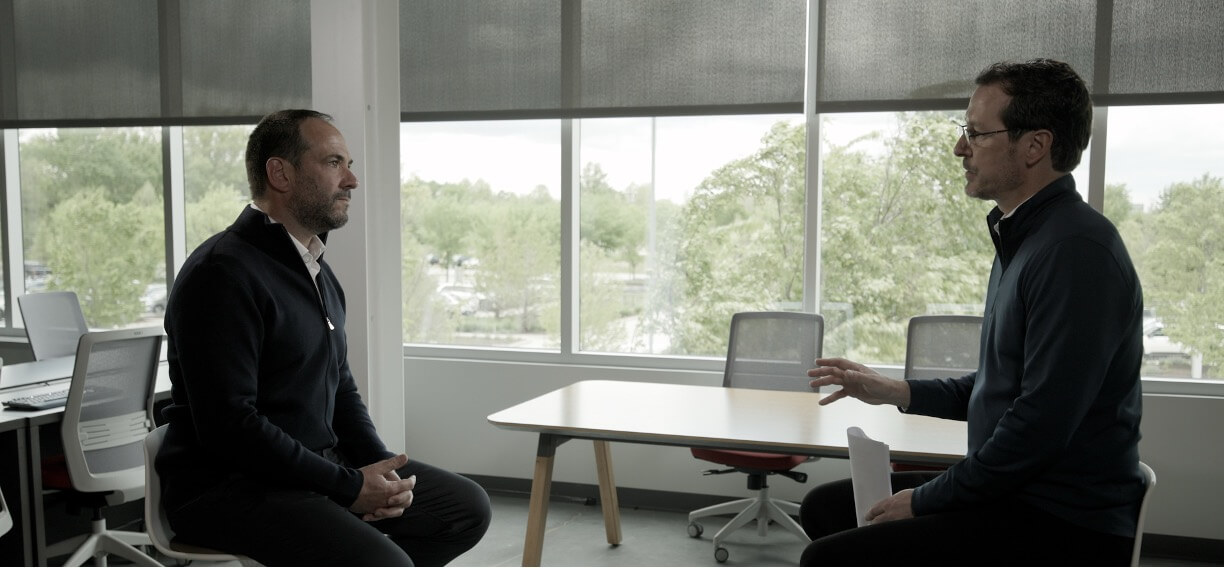
When Puraffinity CEO, Vincent Caillaud visited HG Ventures to attend the Industrial Water Forum, John Glushik took the opportunity to sit down with him to discuss the PFAS contamination challenge, what makes Puraffinity’s technology different, the realities of selling innovation into a conservative water industry, and his advice for founders building at the intersection of climate, regulation, and infrastructure. This conversation has been edited for clarity and length.
How PFAS became a global challenge
John Glushik (JG): Vincent, when you talk to someone outside the water industry, how do you explain why PFAS (Per- and polyfluoroalkyl substances) is such a big issue?
Vincent Caillaud (VC): Before it became such a big issue, there were great chemicals, very useful for their resistance to water, their resistance to abrasion, their resistance to temperature. And they became so useful in our day-to-day life, in our clothes, in our kitchen, but also in industry – and big example is firefighting foams. But because they are so resistant, their main advantage became their main problem. Because they are so resistant, they don’t degrade, they never degrade and hence the words “forever chemicals”.
That’s the whole PFAS story.
And removing PFAS from water is pertinent because water is the main path to human consumption.
A specific solution to a specific problem
JG: PFAS isn’t a new issue. The industry has been working on it for years. What is it about Puraffinity that made you decide to lead the company?
VC: Until now, PFAS has largely been addressed with generic technologies — the same ones the water industry has used for decades to remove all kinds of contaminants. Those technologies do remove PFAS to some extent. It’s such a challenge for the water industry that it deserves a specific technology and one of the most important things about Puraffinity is that Puraffinity has developed, and continues to improve, that specific technology, targeted on PFAS compounds. And that creates a completely different efficiency in terms of removing PFAS from water.
Beyond the performance differentiation, that targeting unlocks much more compact systems, easier standardization and modularization, and the ability to deploy mobile units that move from site to site. The differentiation isn’t only in what the media does, it is in what the media lets the rest of the system become.
JG: Tell us a little more about what is happening scientifically inside the media, the material that the water passes through.
VC: The expertise of Puraffinity is not only on the media, or on one media, the real expertise of Puraffinity is in our capacity to bundle different substrates with different polymers, or different families of polymer, to make products—call it a media—that are exceptionally efficient at targeting PFAS compounds. The work began more than a decade ago in the labs of Imperial College London, and we continue to evolve the polymers, test new substrates, and push the efficiency higher.
Different PFAS compounds don’t react the same way to the same polymer. So, we’re not building one product. We’re building a portfolio of products that we can mix differently depending on the specific water matrix.
Earning trust in a conservative industry
JG: It sounds like a straightforward sale, but as you say, the water industry tends to move slowly. How do you help customers move faster?
VC: I work on my own patience first. I started my career as a project manager in this industry, and project managers want to kill risks. One of the obvious ways to kill risks is to do what you have always done.
There is a kind of resistance to innovation in the water industry. There’s an adversity to risk, which is a good thing, in particular when you’re dealing with potable water, but sometimes these risk-averse habits, become innovation-averse behaviors. We try to fight against that. We fight against that by proving.
We also try to make adoption as easy as possible. We’ve leaned into service-based delivery models, where we rent rather than sell our assets, so the perceived risk for the customer is lower. And in some cases, where the water matrix is known and stable enough, we will guarantee the quantity of media required to treat a given flow. That’s not the habit of the PFAS industry, and it removes another layer of perceived risk — on top of the obvious gain that we are simply more efficient and more affordable.
JG: What has surprised you most in your first chapter at Puraffinity?
VC: A few things have surprised us along the way. The negative surprise is how slow this business [the water industry] can be. The positive surprise is how much and how fast we are able to improve our products and our polymers, and that gives us a lot of ambition and optimism for what comes next.
A third surprise has been on the customer side. PFAS is a regulatory challenge, but because of the inefficiency of the incumbent technology, it is also an operational challenge — a daily headache for the operators who run the system. We’ve found that our best allies inside a customer’s plant are very often those operators. When we come through the door with something simpler and more compact, they become our friends.
Becoming the reference name in PFAS
JG: Where do you see Puraffinity in five or ten years?
VC: You want to become a leader. Success is becoming a leader in a niche. It doesn’t need to be a massive niche, or global niche — but you need to be very good somewhere, you need to be recognized as a leader somewhere. So, we want to be recognized for PFAS removal from water. That’s the only thing; we want to become a reference, we want to become a company, a name people have in mind and that people would call when they have a PFAS challenge or they see an evolution in their PFAS challenge.
Once you have that leadership position, then you go beyond. PFAS removal in itself is not efficient. You need to associate the PFAS removal with detection at the front end and destruction at the back end. The full PFAS loop must be controlled, not simply moved around. We don’t have to do all of that ourselves — partnerships will matter. We first need to be a leader here; the rest will follow from that.
The HG Ventures partnership
VC: Let me turn the question around, John. PFAS is a crowded space at the moment. Why did HG Ventures choose Puraffinity?
JG: We had been tracking PFAS for some time, and we have two real advantages at HG Ventures: a research group inside the Heritage Group that can validate the underlying chemistry, and operating companies that come across these problems in the field every day. We knew we wanted to invest in a technology that had real validation and was very specifically focused on this problem.
And while Puraffinity is based in London — farther afield than our typical portfolio — the conviction was strong enough that geography wasn’t going to be the deciding factor.
We’re always looking for ways to really add value, tangible value, to our portfolio companies, that’s actually part of our investment thesis. And with Puraffinity, we identified a way to do that in the early days. [Puraffinity founder] Henrik [Hagemann] had built a great process and a great new vision for a material, and we were able to take expertise from our research group and we actually took a scientist, a PhD, from our research group, and they went to London, they spent time with the company—they spent a few months—adding some analytics and adding some process to what was already a pretty innovative solution, but now could iterate faster. So, in this particular case, with Puraffinity, we were able to speed up their development process, using the expertise from our great research group.
VC: And what do we bring to you, beyond the obvious?
JG: Well, we value integrity, it’s part of a core value for the Heritage Group. We always talk at the Heritage Group about ‘doing the right thing’. And I think that’s one that always stood out, with Henrik and his team, and now with you and the team and the culture at Puraffinity, is always doing the right thing with high integrity. You’re in an industry where you’re helping the world in so many ways, that feeds into one of the themes we’re always attracted to: sustainability; leaving our communities in a better place. That’s all part of what really drives our company and the Heritage Group. And Puraffinity fit very well into that theme.
Vincent, on the other side — what has the partnership unlocked for Puraffinity, beyond capital?
VC: I see at least three layers. The first is the HG Ventures portfolio itself, where we have peer companies working on adjacent PFAS challenges and a community of common thinking we can tap into.
The second is the Heritage Group’s research and labs, which were extremely valuable to us early in the journey and remain so today.
The third layer is the operating businesses inside the Heritage Group, with Envita as a clear example. They are established players in environmental services and now in PFAS, so they can be partners and also feed back to us important market intelligence we wouldn’t otherwise see.
Lessons for founders at the intersection of climate, regulation, and infrastructure
JG: What advice would you give to founders building hard-tech, climate, or infrastructure companies?
VC: Two main pieces of advice: First, it’s a race against time. Don’t wait too long before you go to the outside world. You will make mistakes. You will get negative feedback on the technology, on the service offer, on something. But you will learn far more from the outside world than from another quarter in the lab.
Second, as soon as you can, bring in people who have already done it. It’s a natural human reaction to want to do everything ourselves. Sometimes it’s just easier and faster to bring in someone who has already walked the road.
JG: You’ve personally made the move from a major industrial company into an early-stage startup. What advice do you have for executives making that transition, and for founders bringing them in?
VC: For people coming from industry: be careful not to impose to your new ecosystem the recipe that worked in the past. Things are often the way they are for good reasons, and you need to take the time to understand them. Even when something looks fragile or improvable, remember that this team built something from scratch, and when you start a business like that, you have a thousand reasons every day to give up. They didn’t. That deserves real respect.
And for founders: be open to giving room to people who come from the industry, even if that means, as in my case, replacing the founder as CEO. The same person isn’t necessarily the right leader at every stage of the company’s journey. You can be excellent at starting something and not the right person to push it into the market — and vice versa. There is nothing wrong with that. It’s the journey.
JG: Closing thought: Where does the moment we’re in — climate, infrastructure, contaminants like PFAS — sit on your agenda for someone thinking about where to spend the next decade?
VC: Take water because it’s the one thing I know is getting higher, and higher, and higher on everyone’s agenda, and especially the agenda of industry. It’s not about dealing with a commodity at the cheapest price anymore, it’s about companies realizing they need to manage water in both quantity and quality if they want to keep operating. That’s a meaningful shift from where we were ten or twenty years ago.
I think anybody who wants to jump into the climate space, to jump into the water industry, I would just say probably yes, that’s a good idea, that’s a good place to be at the moment. Not only because it’s getting higher on the agenda of everybody, but also because it makes sense. I mean it’s getting higher on the agenda of everybody because we all see on a daily basis how important it is, and how important it is to manage it properly.
Founded out of Imperial College London, Puraffinity develops next-generation media targeted specifically at PFAS removal from water. HG Ventures is an investor in Puraffinity and continues to support the company through its research group and the broader Heritage Group network. We are proud to be partners with Vincent and the Puraffinity team as they take on one of the most stubborn contamination challenges of our time.
Watch the full interview here: